Direct Booking Incentives That Actually Work for Short-Term Rentals
Most owners think a direct booking incentive means a discount. A discount is one lever, and often not the best one. This guide covers the incentives that actually get a guest to book on your site instead of Airbnb, the ones that just erode your margin, and how to present an offer so guests notice it.
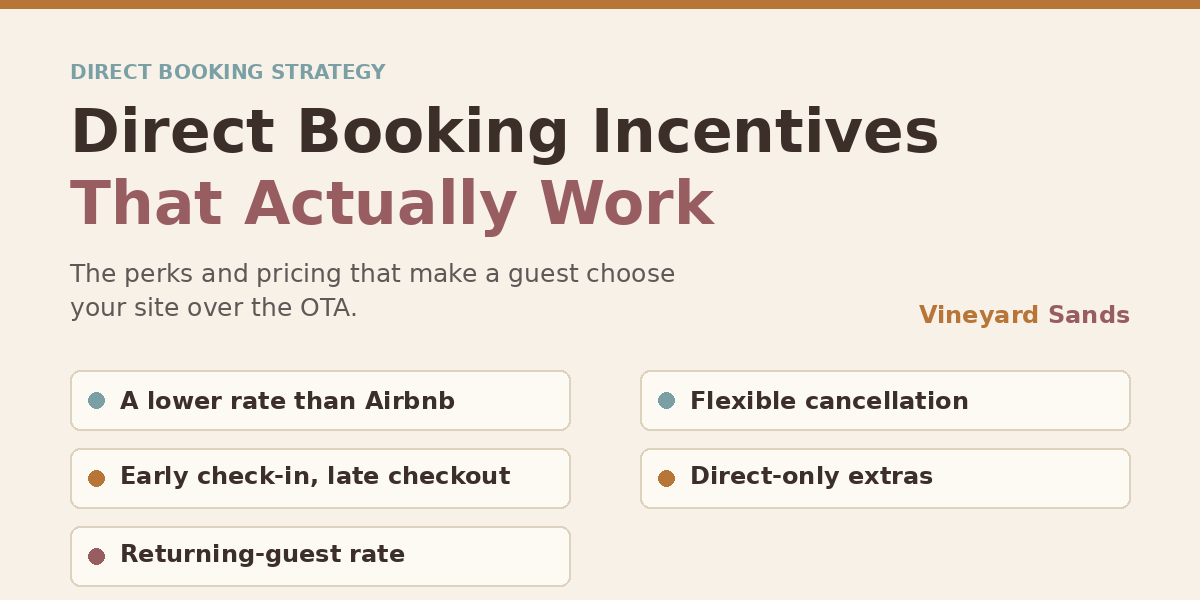
Quick Answer: The direct booking incentives that work all share one trait. They give the guest something the OTA structurally cannot, at a cost lower than the platform commission you avoid. The strongest ones are a rate below your Airbnb price (which now carries Airbnb's roughly 15.5% host fee), perks the platform cannot broker like early check-in or a returning-guest rate, and friendlier terms such as a softer cancellation window. The incentives that fail are deep blanket discounts, freebies with no booking attached, and any offer the guest never sees at the moment they decide.
Ask most short-term rental owners how they get direct bookings and the answer is usually "I knock a bit off the price." Price matters, but a straight discount is the bluntest tool in the box. Done wrong, it trains guests to wait for a deal and quietly eats the margin that direct booking was supposed to protect.
A good incentive does something different. It hands the guest a reason to book with you that Airbnb cannot match, and it costs you less than the commission you are no longer paying the platform. This post covers which incentives actually earn a direct booking, which ones just cost you money, and how to present an offer so a guest acts on it.
What Counts as a Direct Booking Incentive?
A direct booking incentive is anything you offer that tips a guest toward booking on your own site rather than through an OTA. It falls into three buckets: price, perks, and terms.
The useful frame is cost versus commission. In 2026, Airbnb moved almost every host to a single host-only fee of about 15.5%, deducted from your payout. Every direct booking is a booking you keep that 15.5% on. So any incentive that costs you less than roughly 15% of the booking, and still feels valuable to the guest, is money well spent. A late checkout costs you almost nothing. A blanket 20% discount costs you more than the fee you were trying to escape.
The Incentives That Actually Work
These share the same logic. Each one is either free to you, or cheaper than the platform's cut, and each gives the guest something worth crossing over for.
1. A Rate Below Your Airbnb Price
This is the anchor incentive, and it is not really a discount. Because your Airbnb rate is now padded to absorb the 15.5% host fee, your direct rate does not have to carry that cost. Passing it back to the guest gives them a genuinely lower price while you hit the same take-home. The key is to name the savings in dollars. "About $170 less than our Airbnb listing" lands harder than "book direct and save." For the full math on how to set this rate, see how to price direct bookings vs. Airbnb.
2. Perks the Platform Cannot Broker
Airbnb cannot offer an early check-in, a late checkout, a welcome basket, or a mid-stay tidy on your behalf. You can. These cost you little to nothing and read as premium, personal service. A guaranteed early check-in for a family flying in that morning can be worth more to them than a price cut, and it costs you an hour of scheduling.
3. A Returning-Guest Rate
The cheapest booking you will ever get is a repeat one. Offering past guests a standing direct rate, a small loyalty credit, or first pick of dates turns a one-time stay into a habit. This works best when it is paired with a way to reach those guests again, which is where your guest e-mail list and a rebooking follow-up do the heavy lifting.
4. Flexible or Friendlier Terms
A more forgiving cancellation window, a lower deposit, or a hold-the-dates option costs you nothing until it is used, and it removes a real objection. Many guests default to Airbnb because it feels safer to cancel. Matching or beating that flexibility directly takes the safety argument off the table.
5. Longer-Stay and Direct-Only Bundles
A modest weekly or monthly discount rewards the bookings that are easiest to service. Better still is a bundle framed as direct-exclusive: late checkout plus a parking spot plus a local guide, available only when the guest books with you. A bundle feels generous while costing you far less than its sticker value, and it is harder to price-compare against an OTA line item.
The Incentives That Waste Money
These feel generous and quietly work against you.
- Deep blanket discounts. Taking 15% to 20% off every booking gives back the exact margin direct booking was meant to protect, and it trains guests to wait for the next sale.
- Racing below your true rate. Undercutting your own honest price to "win" the booking means you now take home less direct than you would have on Airbnb. That is a loss dressed up as a strategy.
- Freebies with no booking attached. Handing perks to everyone who visits, including browsers who never book, spends real money on people who were never going to commit. Tie the incentive to the action you want.
- Offers the guest never sees. The best incentive does nothing if it is buried on page four of your site. If it is not visible at the moment the guest is deciding, it does not exist.
- Over-stacking. Five incentives at once reads as desperation, not generosity, and it shrinks your take-home. One or two well-placed offers convert better than a pile of them.
How to Present an Incentive So It Converts
The offer matters less than where and how the guest meets it. A strong incentive presented badly gets ignored.
- Surface it at the decision point. Put it where the guest is choosing: your Airbnb bio, your direct booking website, the checkout page, and your follow-up e-mails.
- Name the dollar value. "Save about $170 booking direct" beats "special direct rates available." Specific numbers get acted on.
- Make it direct-exclusive, and say so. The whole point is that this offer does not exist on the OTA. Spell that out so the guest understands why booking direct is the better deal.
- Attach a light condition. "Book direct" or "stay three nights and get late checkout" makes the perk feel earned rather than desperate, and it steers the behavior you want.
- Put it somewhere the guest can act on it. A verbal offer at checkout is forgotten by morning. Get it in writing on your site and in an e-mail they can return to.
A Simple Incentive Stack to Start With
If you are starting from nothing, resist the urge to build an elaborate rewards program. A small, clear stack outperforms a complicated one:
- A direct rate a bit below your Airbnb price, with the savings named in dollars.
- One no-cost perk, usually early check-in or late checkout when the calendar allows.
- A returning-guest rate for anyone who has stayed with you before.
That is enough to make direct the obvious choice without cutting into your take-home. Once it is running, you can test a longer-stay bundle or a flexible-cancellation option and keep whatever moves bookings.
How This Fits Into Your Direct Booking Strategy
Incentives are one lever in a larger system. They work alongside a website guests can actually book on, pricing that protects your take-home, a guest e-mail list you own, and a follow-up sequence that invites past guests back. On their own, incentives nudge. Inside a system, they compound.
The owners who win at direct booking do not out-discount Airbnb. They offer the handful of things a platform cannot, price honestly against the new host fee, and make sure the guest sees the offer at the exact moment they are deciding where to book.
This post is part of the direct booking strategy series.
Related services
- Direct Booking Strategy: SEO, content, and e-mail to reduce OTA dependence.
- Analytics & Foundation: GA4, GTM, and conversion tracking for STR owners.
- Paid Social & Ads: Meta and Google campaigns built for STR audiences.
- Fractional CMO: A full marketing partner for growing STR operators.

About the author
Emily Shepherd is the founder of Vineyard Sands Digital, a boutique digital marketing consultancy for short-term rental owners and hospitality brands. She spent 20+ years inside major digital media brands, including the founding team of MyRecipes.com and its first SEO Editor role. More about Emily →