How to Price Direct Bookings vs. Airbnb: What to Offer Guests
In 2026, Airbnb moved the entire service fee onto the host. Your Airbnb rate now has to carry a 15.5% cost your direct rate does not. This guide covers the new math, whether your direct price should be lower, and what to offer so booking direct is the obvious choice.
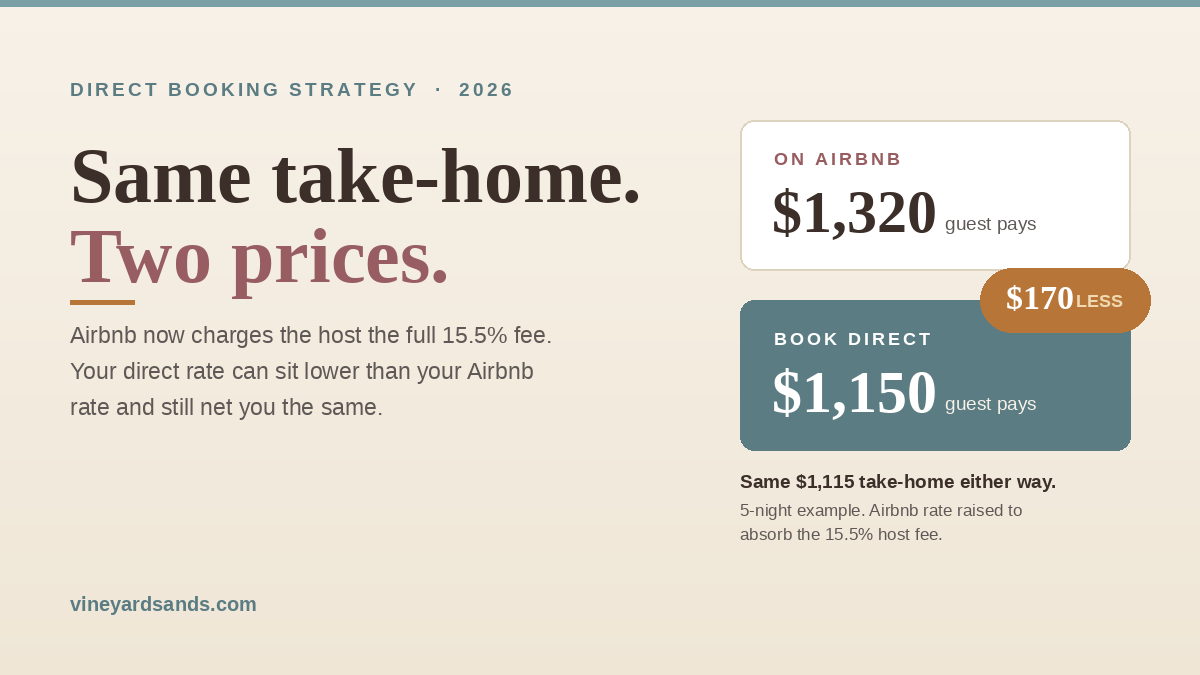
Quick Answer: In 2026, Airbnb shifted the entire service fee onto the host. You now pay a single host-only fee of about 15.5%, taken out of your payout, and your guest no longer sees a separate fee at checkout. To keep the same take-home, most hosts are raising their nightly rates to absorb that 15.5%. That raised number becomes your Airbnb price, not your real price. Book a guest direct and you skip the 15.5%, so you can charge your true, lower rate and still net the same. The guest pays less, and your direct booking rate should sit below your Airbnb rate on purpose.
The old advice was simple: keep your rate the same everywhere, and let the guest save Airbnb's fee. That advice is now out of date.
Airbnb has moved almost every host to a single host-only fee of roughly 15.5%, deducted from your payout, with no separate fee charged to the guest. The change reached software-connected hosts first and is rolling out to everyone else through the fall of 2026.
The result is that the fee is now invisible to your guest. It is buried inside whatever nightly rate you set. To take home the same amount as before, you have to raise that rate. This post covers the new math, whether your direct rate should be lower, and what to offer so booking direct is the obvious choice.
Who Pays the Airbnb Fee in 2026?
You do, in full. Under the old split model, the guest paid a service fee of around 14% at checkout and the host paid about 3%. That model is being retired.
In its place is the host-only fee: a single charge of about 15.5% of your booking subtotal (nightly rate plus cleaning and extra-guest fees, not taxes), taken entirely out of your payout. Your guest sees no separate service fee at all.
That sounds cleaner for the guest, and it is. The catch lands on you. If your nightly rate stays where it was, your take-home drops by roughly 15%. To hold your income steady, you raise the rate. So does every other host. Airbnb list prices are climbing to cover a fee the guest can no longer see.
The New Math: Same Take-Home, Two Different Prices
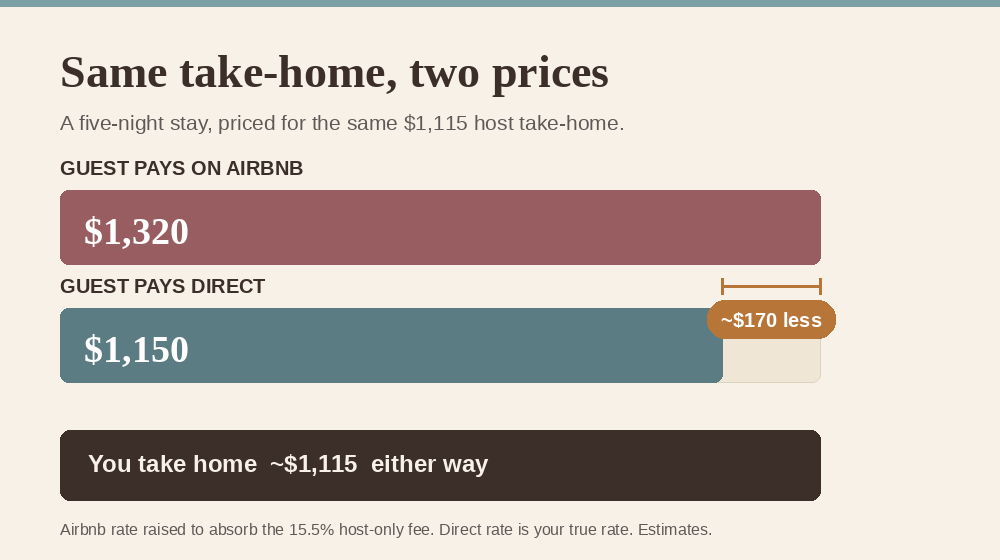
Say your goal is to take home about $1,115 on a five-night stay. Here is what you have to charge on Airbnb to hit that number, next to what you can charge direct.
| Line item | Airbnb (host-only 15.5%) | Direct |
|---|---|---|
| Nightly rate | ~$234 × 5 = $1,170 | $200 × 5 = $1,000 |
| Cleaning fee | $150 | $150 |
| Subtotal | $1,320 | $1,150 |
| Guest service fee | $0 (none in 2026) | $0 |
| Guest pays (pre-tax) | ~$1,320 | ~$1,150 |
| Airbnb host fee (15.5%) | -$205 | n/a |
| Payment processing (~3%) | included | -$35 |
| You take home | ~$1,115 | ~$1,115 |
To net the same money, your Airbnb nightly rate has to climb from $200 to about $234. Direct, you charge your real $200 and pass the difference to the guest. Same take-home for you, about $170 less for them. Fees vary by booking and region, so treat these as close estimates.
Should My Direct Rate Be Lower Than My Airbnb Rate?
Yes, and it is not really a discount. Your Airbnb rate is padded to cover the 15.5% fee. Dropping to your true rate direct just removes the platform's cut. You are not giving anything away.
There are three sensible ways to set a direct booking rate:
- Charge your true rate direct. The un-padded number you would set if no platform took a cut. The guest saves the roughly 15% you no longer have to bake in, and you hit your target take-home. This is the honest, easy-to-explain default.
- Split the difference. Price direct above your true rate but below your inflated Airbnb rate. You net more than an Airbnb booking, and the guest still saves. Useful for high-demand dates.
- Match your target income, compete on perks. Hold your rate closer to the Airbnb number and add value instead of cutting price: early check-in, late checkout, a welcome basket.
Pick on purpose. The one rate to avoid is copying your padded Airbnb price straight onto your own site.
What to Offer Guests So Direct Wins
Price is one piece. The rest is everything the platform cannot give a guest.
- A lower rate than Airbnb. Your Airbnb price is inflated to cover the 15.5% fee. Direct, you pass that back. Name the savings in dollars: "about $170 less than our Airbnb listing" lands harder than "book direct and save."
- Direct communication. The guest talks to you, not a platform inbox.
- Flexible terms. A friendlier cancellation window or an earlier check-in costs little and reads as premium.
- Small perks. A local guide, a late checkout, or a returning-guest rate all cost less than a platform commission.
- A better return path. Once a guest books direct, you can invite them back through your own e-mail list instead of hoping Airbnb resurfaces you.
Match the offer to your direct booking strategy rather than piling on discounts you do not need.
What About Price Parity?
Under the old model, the advice was to hold the same rate everywhere. The host-only fee changes that. Your Airbnb rate now includes a 15.5% cost your direct rate does not carry, so the two prices are not meant to match.
There is also no guest service fee left for Airbnb to compare against. The guest sees one number on Airbnb and a lower number on your site, and the gap is simply the platform's cut.
Set your direct booking rate to your true target income. Let your Airbnb rate carry the fee. A direct price below your Airbnb price is the expected outcome in 2026, not a violation of anything.
Common Pricing Mistakes That Cost You Money
Not raising your Airbnb rate to cover the 15.5%. If your old rate stays put under the host-only fee, you quietly lose about 15% of your income on every Airbnb booking.
Copying your padded Airbnb rate onto your direct site. That overcharges your direct guests and erases the one advantage direct booking gives them.
Hiding the savings. The guest can no longer see a fee line, so they cannot tell direct is cheaper unless you show them. Spell out the dollar difference.
Forgetting processing costs. Build the roughly 3% payment processing fee into your direct rate so your take-home is a real number. Most direct booking software shows this before you set a price.
How This Fits Into Your Direct Booking Strategy
Pricing is one piece of a larger system. It works alongside a website guests can actually book on, a follow-up sequence that invites past guests back, and a direct booking strategy built to reduce OTA dependence.
The 15.5% host fee is a real cost, but it also hands you a clean pitch. Your Airbnb rate has to carry Airbnb's cut. Your direct rate does not. The owners who win in 2026 set a direct price that protects their take-home, show the guest exactly what they save, and make the return trip easy.
This post is part of the direct booking strategy series.
Related services
- Direct Booking Strategy: SEO, content, and e-mail to reduce OTA dependence.
- Analytics & Foundation: GA4, GTM, and conversion tracking for STR owners.
- Paid Social & Ads: Meta and Google campaigns built for STR audiences.
- Fractional CMO: A full marketing partner for growing STR operators.

About the author
Emily Shepherd is the founder of Vineyard Sands Digital, a boutique digital marketing consultancy for short-term rental owners and hospitality brands. She spent 20+ years inside major digital media brands, including the founding team of MyRecipes.com and its first SEO Editor role. More about Emily →